
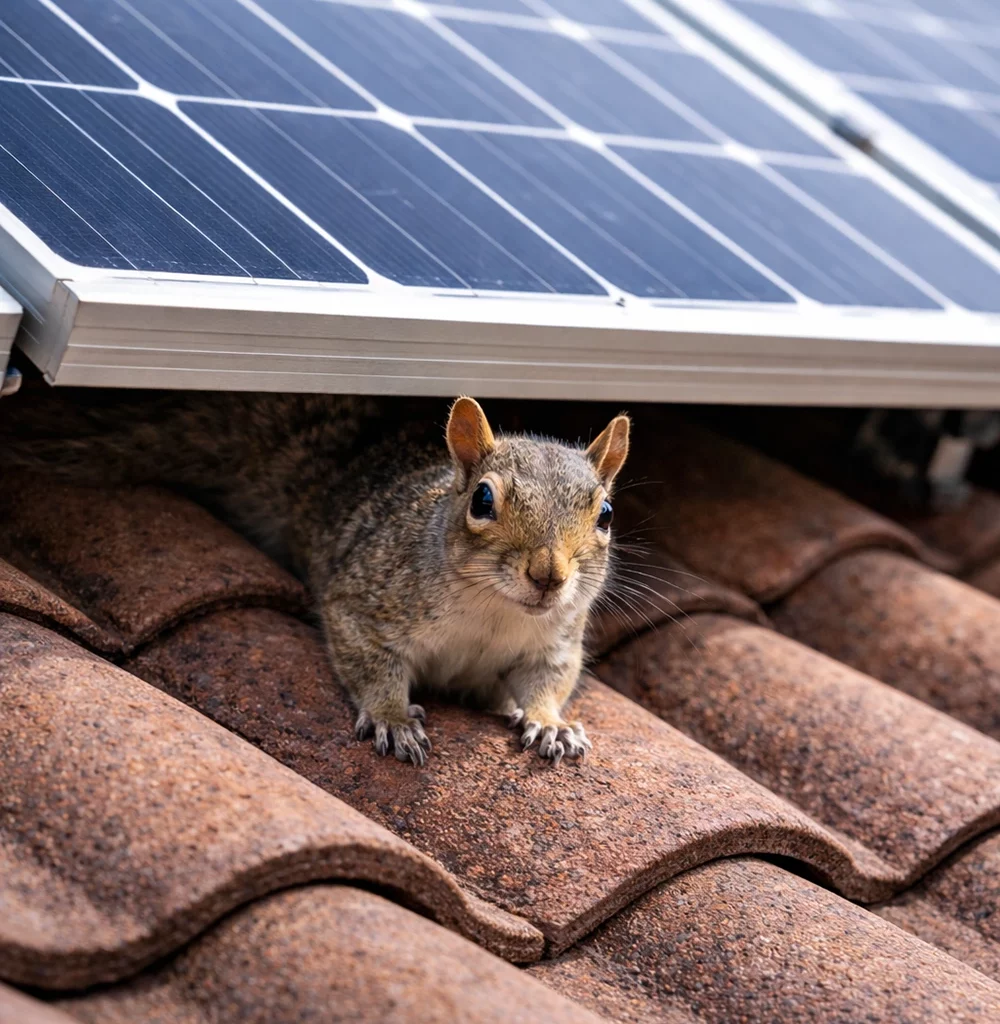
Wildlife and Solar Panels
Solar panels are a significant investment and a smart one, especially here in Central Texas where the sun cooperates more often than not. But there’s a side effect of rooftop solar that installers don’t always warn you about: the gap between your panels and your roof is prime real estate for wildlife.
We’ve been seeing more and more solar panel exclusion jobs across the Greater Austin area, and the pattern is consistent. By the time a homeowner or property manager calls us, the problem has usually been going on a lot longer than they realized. Here’s what you actually need to know.
Why Solar Panels Attract Wildlife in the First Place
Think about it from an animal’s perspective. Your rooftop solar array offers a space that’s elevated and hard for predators to reach, sheltered from rain and wind on three sides, warmed by the panels absorbing sunlight above, and largely undisturbed by humans. For birds, that’s a perfect nesting cavity. For squirrels and rats, it’s a secure den with easy access to the wiring and insulation they’ll chew through without a second thought.
Central Texas makes this worse than a lot of other regions. Our mild winters mean birds nest year-round rather than seasonally, and our large urban squirrel and roof rat populations mean there’s constant pressure on available nesting sites. Solar panels are relatively new, abundant, and largely unprotected, which is why we’re busier on this service than ever.
The Three Culprits We See Most Often
Pigeons
Pigeons are the most common solar panel wildlife problem we deal with, and they cause more cumulative damage than most people expect. They pack the space under panels with dry nesting material including grass, twigs, and feathers, all of which sits directly next to electrical wiring. Their droppings are acidic and corrosive, degrading both panel surfaces and the roofing material underneath over time. They also block the airflow that panels need to stay cool and operate efficiently. Because pigeons are social and habitual, one nesting pair quickly becomes a colony.
Squirrels
Squirrels are the most dangerous wildlife problem for a solar system. They chew through wiring not out of malice but compulsively, because that’s simply what squirrels do. Chewed wiring means electrical shorts, power loss, and in serious cases, fire. We’ve seen squirrel damage that required thousands of dollars in wiring repairs that would have cost a fraction of that with a proper exclusion barrier installed upfront. If you’ve seen squirrels on your roof, your solar panels are a likely destination.
Roof Rats
Roof rats are extremely common in Central Texas and are well adapted to navigating rooftops. Like squirrels, they chew wiring and nest in the space under panels. Unlike squirrels, they’re also a strong indicator of a broader intrusion. If rats are getting under your solar panels, they may also be getting into your attic through the same or nearby entry points.
Signs You Have a Problem


The tricky thing about solar panel wildlife activity is that it’s largely hidden. By the time you’re seeing obvious signs, the damage is usually already done. Here’s what to watch for:
- Birds consistently flying to or from the edge of your solar array
- Chirping, scratching, or rustling sounds from the roof, especially in the early morning
- Droppings on the panels, on the roof below the array, or on gutters directly beneath the panels
- Nesting material visible at the edges of the panels
- A noticeable or unexplained drop in your system’s energy output
- Squirrels or rats seen on or near the roofline
Any one of these is worth taking seriously. If you’re seeing more than one, there’s almost certainly an active problem under your panels right now.
What the Fix Actually Looks Like

The solution is a professionally installed exclusion barrier around the perimeter of your solar array. It’s typically a heavy-gauge galvanized or stainless steel mesh that attaches to the panel frames and seals the gap between the panels and the roof completely, with no openings large enough for birds, squirrels, or rats to squeeze through.
The key word is professionally. The mesh you’ll find at a hardware store isn’t built for this application. It’s not heavy enough to deter squirrels, it’s not UV-rated for outdoor longevity, and improper installation can create gaps, damage your roof, or void your panel warranty. We use Bird B Gone commercial-grade materials as part of a complete process that includes removing any existing wildlife, cleaning and disinfecting the area under the panels, and then installing the barrier on a clean surface.
Installing a barrier over an existing nest or droppings without cleaning first is unfortunately common in this industry. It creates ongoing health hazards and fire risks, and it’s not something we do.
The Right Time to Do This Is Before You Have a Problem
If your solar panels are newly installed and wildlife-free, exclusion is a straightforward, relatively low-cost preventative measure. If you already have birds or squirrels under your panels, the job is more involved. It requires removal, cleanup, and sanitation before the exclusion barrier goes in, and the underlying wiring damage may need to be addressed separately.
Either way, it’s worth dealing with sooner rather than later. The longer wildlife has undisturbed access to the space under your panels, the more nesting material accumulates, the more wiring is at risk, and the more your roof absorbs damage from droppings and debris.
If you’re in the Greater Austin or Central Texas area and want to know what’s going on under your panels, we offer free site assessments with no obligation. We’ll tell you exactly what we find and what it would take to fix it.
Learn more about our solar panel wildlife exclusion service or request a free quote.
