
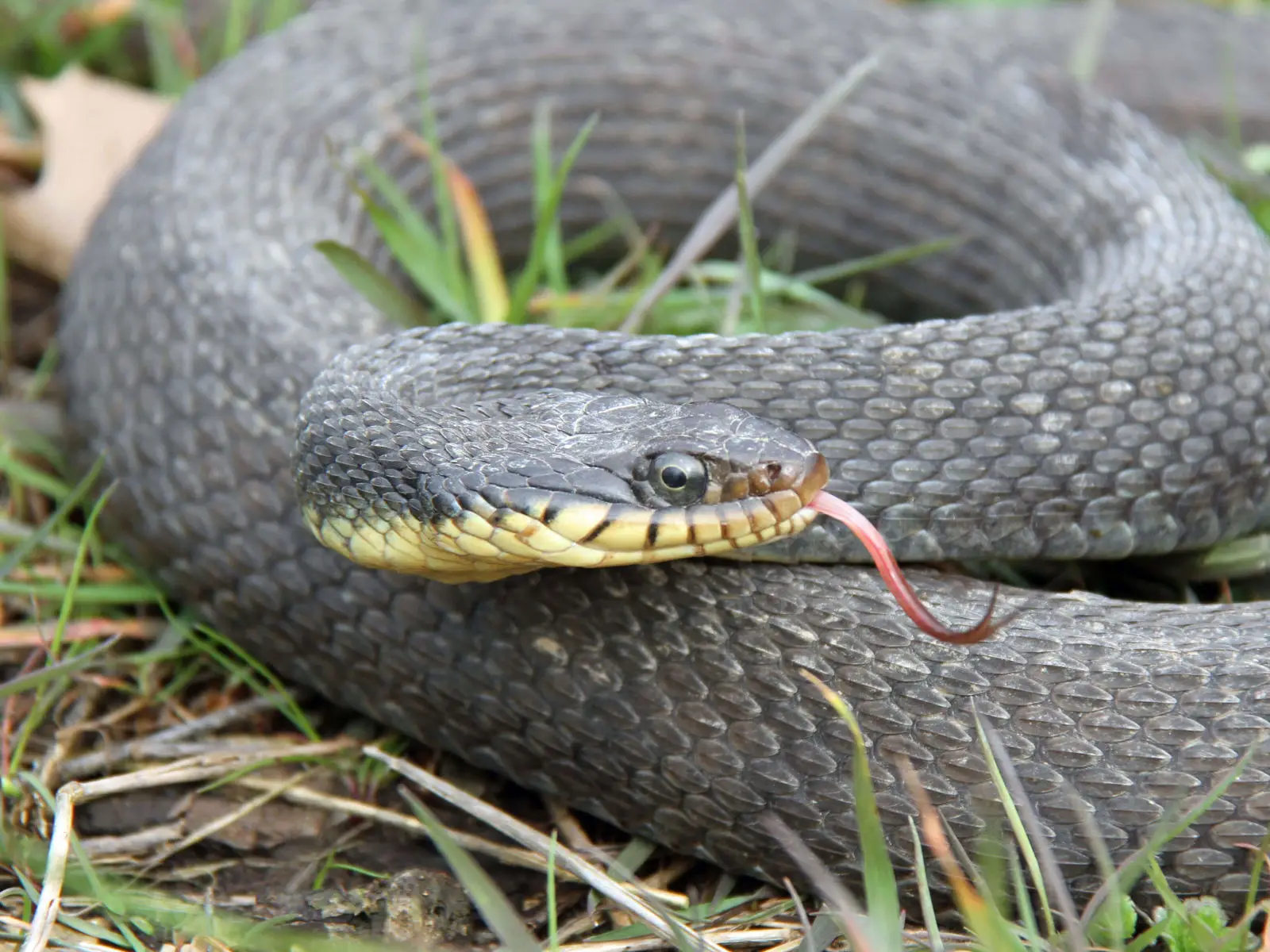
Water Snakes in Central Texas
How to identify them, where they live, and what to do if you find one on your property
What is a Plain Bellied Water Snake
The plain bellied water snake (Nerodia erythrogaster) is a nonvenomous aquatic snake found throughout the southeastern United States, including Central Texas. It is often confused with venomous species because of its size and behavior, but it poses no threat to people when left alone. These snakes are skilled swimmers and spend most of their time near rivers, ponds, creeks, and marshy areas.
Identification

Unlike many water snakes with patterned bellies, this species has a solid color underside that can be yellow, orange, or red depending on region. The back is typically dark green, gray, brown, or black. Juveniles may have subtle banding that fades as they mature. Body lengths range from two to four feet, though larger individuals are sometimes reported.
- Belly: Solid color, no markings
- Dorsal Color: Dark and uniform
- Head Shape: Rounded, not triangular
- Pupils: Round, not slit-like
They often flatten their heads when threatened, which can make them look similar to venomous snakes, leading to misidentification.
Behavior and Diet

Plain bellied water snakes are active hunters that feed on frogs, fish, tadpoles, salamanders, and other aquatic prey. They are more terrestrial than many other water snakes and will travel away from water in warm seasons. They are not aggressive but will defend themselves if handled or cornered, often releasing musk or striking defensively.
Habitat in Central Texas
They prefer slow or still waters including lakes, retention ponds, cattle tanks, drainage areas, and creeks. Suburban expansion and water-adjacent neighborhoods increase sightings, especially in areas like Round Rock, Georgetown, Cedar Park, and communities bordering Brushy Creek and the Hill Country river systems.
Are Plain Bellied Water Snakes Dangerous
No. They are not venomous and are not considered medically dangerous to humans or pets. The primary risk comes from mistaken identity. Many people confuse them with cottonmouths, which can lead to unnecessary fear or the snake being harmed.
How to Tell Them Apart from Venomous Snakes
- Round pupils instead of vertical slit pupils
- Vertical stripes on jaw, lacks the “eye band” of the cottonmouth
- Uniform coloration on belly rather than patterned scales
- Narrow head rather than large triangular shape
- More likely found swimming with entire body visible on surface
If you are not certain, it is safer to keep distance and call a professional.
What to Do if You Find One on Your Property
In most cases, they simply pass through in search of water or food and do not require removal. Homeowners near ponds, golf courses, community lakes, or greenbelts may see them more frequently in spring and summer. If the snake is inside a structure or presents a safety concern, professional removal is recommended.
MB Wildlife Control Services
We offer humane snake removal, property inspections, and exclusion work such as sealing gaps in foundations, repairing mesh under decks, and advising on habitat modifications. We never use poisons or snake repellents because they are ineffective and unsafe for pets and wildlife.
Service Areas: Austin, Round Rock, Cedar Park, Georgetown, Lakeway, Dripping Springs, and nearby communities.
Contact MB Wildlife Control
If you need help identifying or removing a snake on your property, reach out anytime.
MB Wildlife Control
Phone: (512) 522-1780
Email: [email protected]
Website: www.mbwildlifecontrol.com
